Official Competition Rules

Humanoid Battle — Official Rules

A one-on-one humanoid robot tournament — earn points with valid techniques that knock over or push the opponent's robot out of the arena. Leagues are divided by age and weight class.

📄 Official PDF (EN)🗓 Revision: Ver 25.06.30📑 Korean original (HWP)

Verification of Regulations — Sangbok Park, Chief Judge of IREA

Humanoid Battle — Official Rules

1Overview

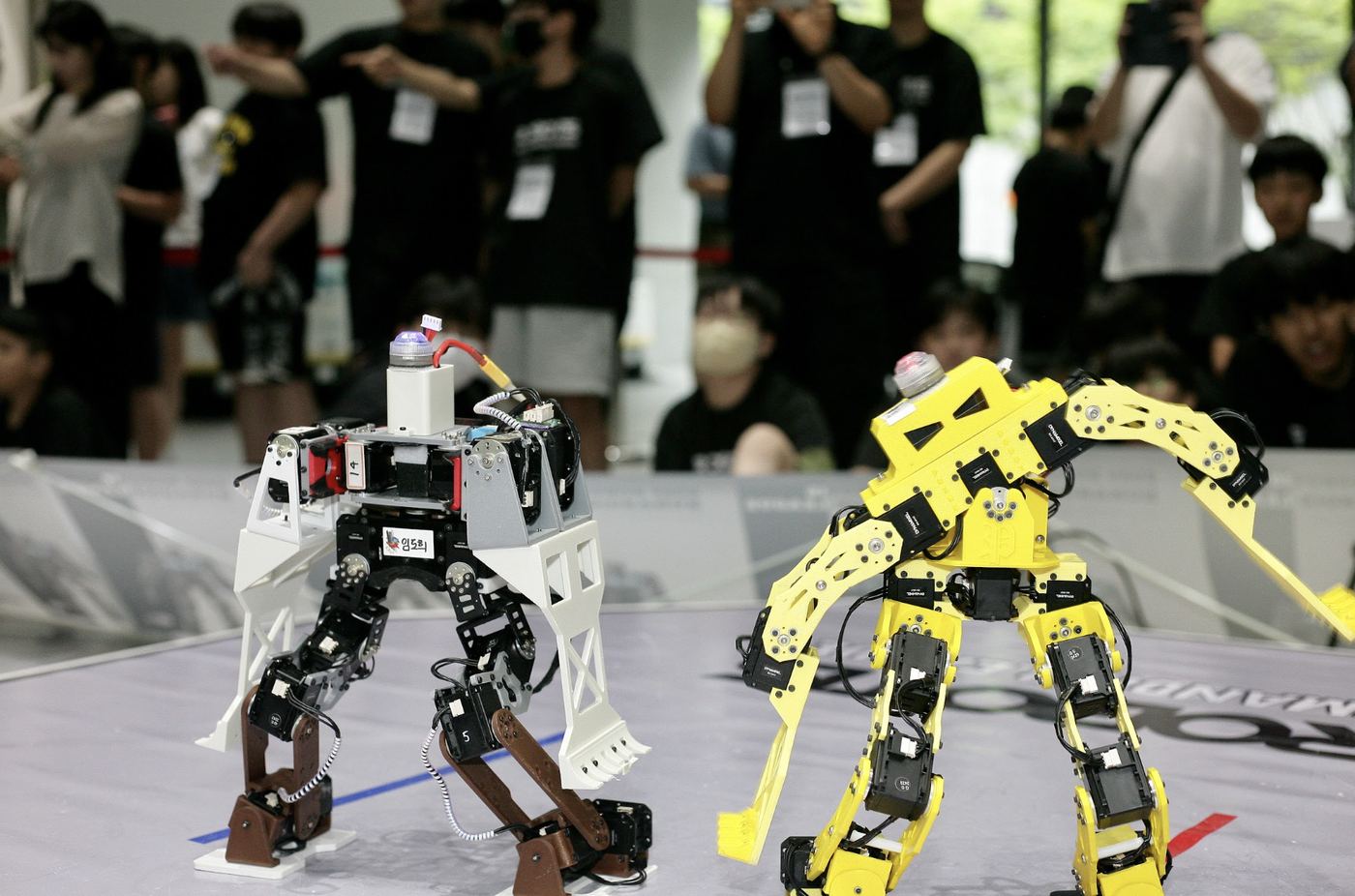
"Humanoid Battle" is a competition that involves the diverse use of humanoid robots, emphasizing sportsmanship, respecting opponents, and sharing technical skills in a festive atmosphere. The event is a one-on-one tournament where participants control humanoid robots to earn points by using valid techniques to knock over or push the opponent's robot out of the arena. Participants compete in leagues based on their age and the weight class of their robots.

※ The tournament format may change depending on the number of participants on the day. After all matches are concluded, group rumbles and event matches may take place.
※ Not all weight classes are open for every competition — only select classes are open for each event. Please check the posters and announcements to confirm the weight classes for each competition.

2Participation Categories

2-1. League categories (age)

ClassJuniorSeniorPro
MinimumAges 7~15
FlyweightAges 7~12Ages 13~18
BantamweightAges 7~12Ages 13~18
FeatherweightAges 7~12Ages 13~Adult
LightweightAges 7~12Ages 13~Adult
MiddleweightAges 7~Adult
HeavyweightAges 7~Adult

2-2. Weight class categories

ClassWeight class
MinimumCommercial products and self-made robots under 0.7 kg
FlyweightCommercial products and self-made robots under 1.0 kg + minimum class standard robots
BantamweightCommercial products and self-made robots under 1.5 kg + flyweight class standard robots
FeatherweightCommercial products and self-made robots under 1.7 kg + bantamweight class standard robots
LightweightCommercial products and self-made robots under 2.0 kg + featherweight class standard robots
MiddleweightCommercial products and self-made robots 2.7 kg or less + lightweight class standard robots
HeavyweightSelf-made robots under 3.5 kg and middleweight robots + middleweight class standard robots
2-2-1The robot specification allows a weight tolerance of up to +3g.
2-2-2Participants are allowed to compete in a weight class one level higher than their current grade, while maintaining the robot specifications of their current grade, under the condition of voluntary or overlapping participation.

3Robot Specifications

3-1Robot base platform — only humanoid robots that have a structure resembling a human (head, torso, arms and legs) and comply with the robot specifications regulations are eligible to participate.
The robot specifications allow a tolerance for length exceeding by up to +1mm.
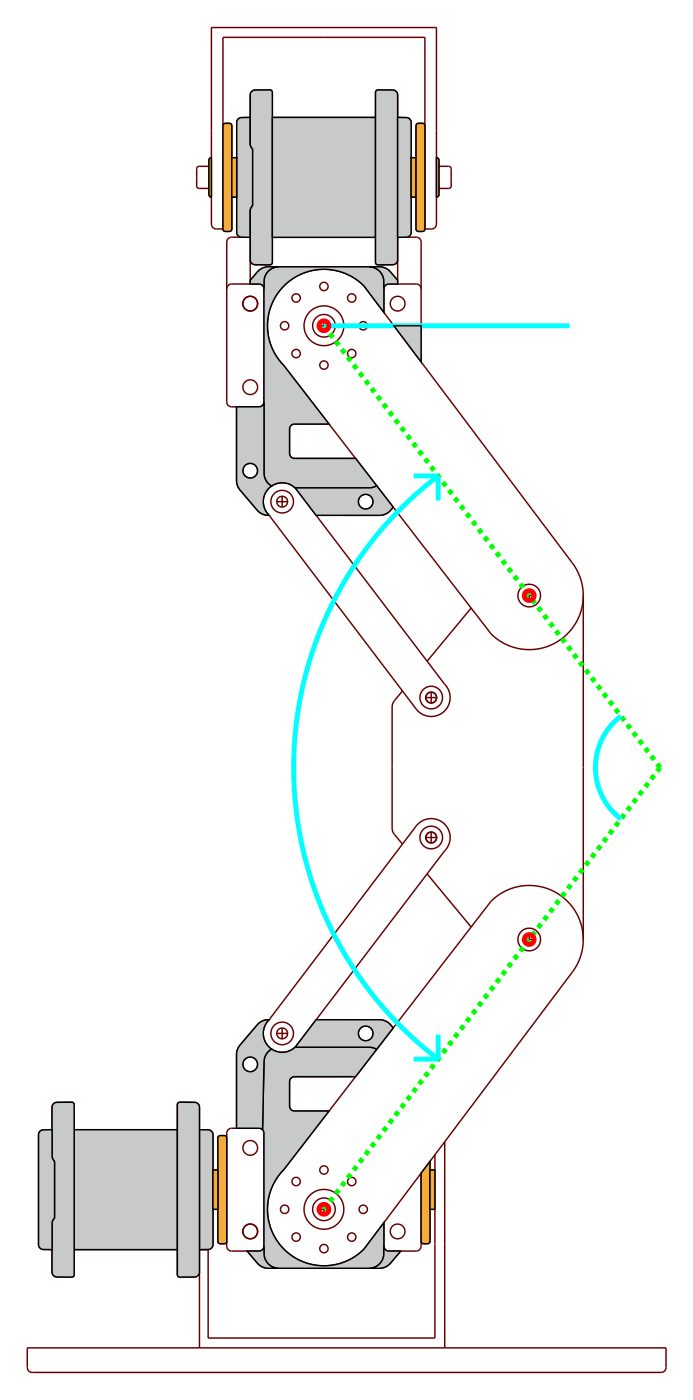
3-2-1Basic posture — the "specification posture height" is measured when the robot is fully extended, while the "basic posture height" is measured when the knee angle is 90° or more. The basic posture height is measured from the ground to the highest of the head or chest axes. During all walking and attacking, the robot must always maintain the height limit of the basic posture. "Basic stance" refers to the angle of the knees and the alignment of the upper and lower body.
ClassHeight limit in the basic posture
Minimum200mm or more
Flyweight200mm or more
Bantamweight300mm or more
Featherweight300mm or more
Lightweight300mm or more
Middleweight350mm or more
Heavyweight400mm or more
Fig. ❶ "Basic stance" — the angle of the knees and the alignment of the upper and lower body, maintaining 90 degrees or more.
3-2-2All other robot specifications must be constructed in accordance with the Humanoid Standard Regulation.

4Rules of the Game

4-1. Methods of play

4-1-1Within a time limit of 3 minutes (1 minute in overtime), the participant who obtains more "downs" from the opponent wins by decision.
4-1-2If 5 downs are obtained, a "TKO victory" is declared and the match ends.
4-1-3If a "slip down" or "down" occurs and the participant cannot return to the basic stance within a 10-count, a "KO loss" is declared and the match ends.
4-1-4If a "disqualification loss," "forfeit loss," or similar is declared, the match ends.

4-2. Rules regarding a "down"

4-2-1The criteria and judgment regarding a "down" rest solely with the referee's absolute authority.
4-2-2If an opponent's robot is knocked over by a precise strike, one point ("down") is earned.
4-2-3If a robot touches the robot being counted during the count after a "down" is declared, it is considered a violation of the down rule and results in a "disqualification loss."
4-2-4Each participant's first warning is treated as a verbal warning; subsequently, each accumulation of one warning results in a one-down penalty.

4-3. The "slip down" rule

4-3-1Areas of the robot excluding the sole of the foot (including the sides of the foot) must not touch the floor of the arena during the match. Violation results in a "slip down" declaration, and intentional slip downs may result in a warning. However, "critical attacks" are exempt from this rule.
4-3-2If the attacking robot is declared a "slip down" after successfully achieving a "down," the down will not be recognized or counted.

4-4. The "ring out" rule

4-4-1If a robot falls or goes outside the competition area, a "ring out" is declared and the robot is penalized with a one down.
4-4-2If a participant touches a robot that is attempting to fall out of the competition area before it is declared a "ring out," it still results in a one down penalty.

4-5. The "time" regulation

4-5-1During the match, participants may request a "timeout" from the referee in case of rule violations or if there is a malfunction or issue with their robot. They are allotted a repair time of 2 minutes, and each 2-minute timeout is counted as one down.
4-5-2Once a "down" (that is not a slip down) is declared, requests for a timeout will not be accepted, and the count and the match will continue as usual.
4-5-3Requests for a timeout due to important inquiries or objections will not result in a one down penalty. However, if the referee determines that the request is not valid, a warning may be issued.
4-5-4Timeout requests can be made up to a maximum of 2 times per match, totaling 4 minutes. If a participant cannot return to the match after this allotted time, they will be declared the loser by KO.

4-6. Standing down rule

4-6-1If a robot remains inactive for 5 seconds or more, the referee can declare a "standing down." A standing down results in a one down penalty, and if the robot fails to return within the 10-count after the declaration, it will be declared a "KO loss."
4-6-2Participants who have been declared a "standing down" can request a timeout, during which they are allotted 2 minutes for repairs. Additionally, they will receive an additional one down penalty.

4-7. The KO (Knockout) rule

4-7-1When a "standing down," "slip down," or "down" is declared, the participant must rise within a 10-count. If unable to return to the basic stance, a "KO loss" is declared and the match ends.
4-7-2The 10-count does not necessarily mean one count per second. The counting speed is at the discretion of the referee based on the flow of the match and the situation at hand.

4-8. The "defensive stance" regulations

4-8-1During walking and attacking, the basic stance must always maintain a knee angle (between the thigh and the calf at the knee joint) of at least 90 degrees. Angles less than this are considered a "defensive stance."
4-8-2If the shoulder axis drops below the hip axis, it is also judged as a "defensive stance."
4-8-3Maintaining a defensive stance for more than 3 seconds, or sitting down, is not allowed. After releasing the defensive stance, walking for 3 steps or more is required. Failure to comply results in a warning. This rule also applies to critical attacks.
4-8-4In a defensive stance, even if an attack is successful, it will not be recognized as a "down," and a warning will be issued. However, critical attacks are an exception to this rule.

4-9 & 4-10. Attacks & frontal attack

4-9-1During an attack, all attacks except those considered "slip downs" or made in a "defensive stance" are permissible, including attacks from all directions (360°).
4-10-1If an attacking robot accurately strikes the upper body (head, chest, back) of the opponent robot with a pushing attack between the attacking robot's legs as a frontal attack, causing the opponent robot to fall both forwards or backwards, it is recognized as a "frontal attack" and results in a two-down penalty.
4-10-2If the attacking robot experiences a "slip down" after a successful frontal attack, the attack will not be recognized.
4-10-3The authority to attempt and determine the success of a frontal attack rests with the referee. There is no limit on the number of frontal attacks that can be performed. (4-10-4)

4-11. Critical attack regulations

4-11-1If a robot executes a significant attack or kicking technique that clearly lifts both feet of the opponent robot off the ground and causes them to fall over, it is recognized as a "critical attack" and results in a two-down penalty.
4-11-2A "critical attack" refers to techniques such as charging in, sweeps, backdrops, uppercuts, flying kicks, kicks, tumbling, and similar maneuvers that deliver significant impact to the opponent. The authority to attempt and determine the success of a critical attack rests with the referee.
4-11-3According to the referee's judgment, if a robot successfully executes an attack that completely immobilizes the opponent robot and lifts both of its feet completely off the ground, the attack is considered a successful critical attack even if the attacking robot subsequently experiences a "slip down."
4-11-4A "kick" attack can be attempted even from a defensive stance, and if the attacking robot knocks over the opponent with a kick and subsequently experiences a slip down, the attack is still recognized as a successful critical attack. A kick can be attempted even when one hand is touching the ground. (4-11-5)
4-11-6A critical attack is limited to a total of one per match. However, a kick attack can be attempted once in addition to the critical attack. In overtime, critical attacks are also limited to one attempt. Additionally, even if a critical attack is used in this match, it can be attempted again (in the next match). Unreasonable attempts without any chance of success, and attempts exceeding the allowed limit, are considered match delays, resulting in a warning. (4-11-7)

4-12. Walking regulations

4-12-1During walking, it is not permissible to maintain a defensive stance. Each violation results in a warning. If it is determined that every instance of walking violates the regulation, a 2-minute correction time is granted, counted as 1 down. If correction is not possible, the violation leads to a "disqualification loss."
4-12-2The robot must be able to walk in at least two directions (front, back, left, right) for a minimum of 5 steps each without falling over. Referees can request verification at any time before or during the match, and a robot that fails this test will be disqualified for violating the walking regulations.
4-12-3If any part of the robot, excluding the recognized soles of the feet, touches the playing field during walking, attack or defense, it will be immediately processed as a "slip down" or "down."
4-12-4During walking and direction changes, both shoulders' and both chest's axes must always maintain horizontal alignment with the playing field surface. Any walking motion that fails to maintain this alignment will be judged as a "defensive stance," and a warning will be issued. The allowable tolerance for the chest axis deviation from horizontal is up to ±10 degrees.

4-13. Other regulations

4-13-1When resuming the game after the start or after a "slip down" or "down," the robots must maintain a distance of at least 50cm (approximately two spans) apart. Deliberately violating this distance will result in a warning. However, in featherweight and lighter weight classes, the minimum distance allowed is 20cm (approximately one span).
4-13-2A robot that has fallen cannot be attacked. A warning will be issued if this rule is violated.
4-13-3If a part with a side length of 3cm or more, or a part weighing 5g or more, falls off during the match, or if the battery becomes detached and protrudes even slightly outside the robot, the match will be immediately halted and 2 minutes of repair time will be given, counted as 1 down. If normal repairs are not possible, it will be considered a "TKO loss."
4-13-4During the match, robots may not be touched without the referee's permission. Violating this rule may result in a warning, down, or disqualification at the referee's discretion.
4-13-5If a defensive strategy is employed during the match, a warning may be issued at the referee's discretion.
4-13-6If the referee signals "stop" during the match, the robot must immediately cease operation and halt movement. Violating this rule will result in a warning.
4-13-7If the robots become entangled, the referee may declare a "torque-off," and participants must immediately cut off power to the motors.
4-13-8Due to a referee's error or decision, the match or the declaration of win or loss may be overturned and the match may be resumed, even after it has concluded.
4-13-9If a participant or their affiliate disagrees with the referee's judgment (which is the referee's exclusive authority), shows a lack of respect, or makes excessive complaints, a first warning will be issued. If noncompliance and repeated protests continue, it will result in immediate disqualification.
4-13-10During the match or when the match is paused, when the referee provides explanations regarding decisions or rules, participants should signify their understanding by saying "Yes" and giving a simple nod.

4-14. Terminology

The following terms are used during matches (Korean referee calls with their meanings). Participants should familiarize themselves with these terms in advance.

레디 · Ready파이트 · Fight다운 · Down노카운트 · No-Count스탠딩다운 · Standing-down링 아웃 · Ring-out토크오프 · Torque-Off떨어져 · Distance경고 · Yellow-Card타임 · Time스톱 · Stop그만 · Game-Over승 · Win차렷 · Attention인사 · Bow디스퀄리피 · Disqualify득점 · Point정면공격 · Frontal Attack
4-14-2Any matters not otherwise specified shall be determined according to the decision of the judging committee on the day of the event.

5Robot Modifications

5-1-1After completing the specification inspection, if modifications are necessary due to abnormalities or other reasons, participants must obtain permission from the referees before making any changes (during the match, this counts as 1 down). If participants make changes without permission, it will result in disqualification.

6Evaluation Methods

6-1. Basic evaluation

6-1-1Participants who adhere to the established regulations and obtain outcomes such as KO, TKO, decision win, disqualification (of the opponent), or forfeit against their opponent within the allotted time will achieve victory.
6-1-2Depending on the situation, multiple robots can engage in a group competition known as a "Rumble" match to determine rankings. In a Rumble match, even fallen robots can be attacked. Participants who are "ringed out" or "down" immediately lose, and the robot remaining on the arena floor or removing "mission objects" ultimately wins.

6-2. Evaluation of a draw

6-2-1In the event of a tie, teams immediately enter a 1-minute extension period without additional time for battery replacement or repairs. The team that scores the first point wins by "Golden Down." Any remaining warnings that are not counted as scoring infractions are carried over into the extension period.
6-2-2If the match remains undecided after the extension period, the evaluation priority is as follows: the team with fewer warnings → the team with fewer slip downs during the extension → if priority is still unclear, another extension period may be conducted → the team with the lighter robot weight. These criteria determine the outcome if the match is still tied after overtime.

6-3. Disqualification regulations

6-3-1Participating in a match using another participant's robot.
6-3-2Refusal to comply with the referee's instructions or decisions.
6-3-3Violation of robot specifications during the match.
6-3-4Leaving the arena or designated waiting area without referee permission.
6-3-5Using profanity or engaging in violent behavior.
6-3-6Engaging in any unsportsmanlike conduct or misconduct that disrupts the course of the match.
6-3-7If a participant is unable to compete after all other matches have concluded.
6-3-8If a participant is disqualified, the record of that match is not recognized.
6-3-9In the case of disqualification or intentional actions that compromise fairness by a participating team or individual, the IREA may permanently revoke their eligibility to participate in IREA-sanctioned competitions through a deliberation council meeting.

7Arena Specifications

Below are the arena specifications. The layout is an example and is subject to change based on conditions on the day of the match.

ClassArena size (W × L × H)Floor material
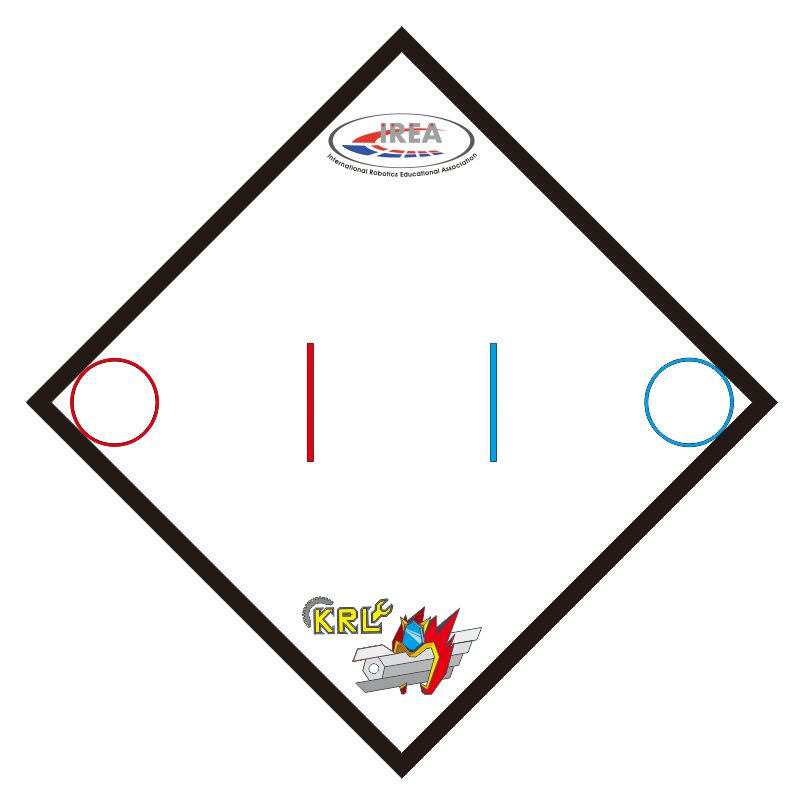
Minimum · Flyweight90 × 90 × 10 cm (±5%)PET
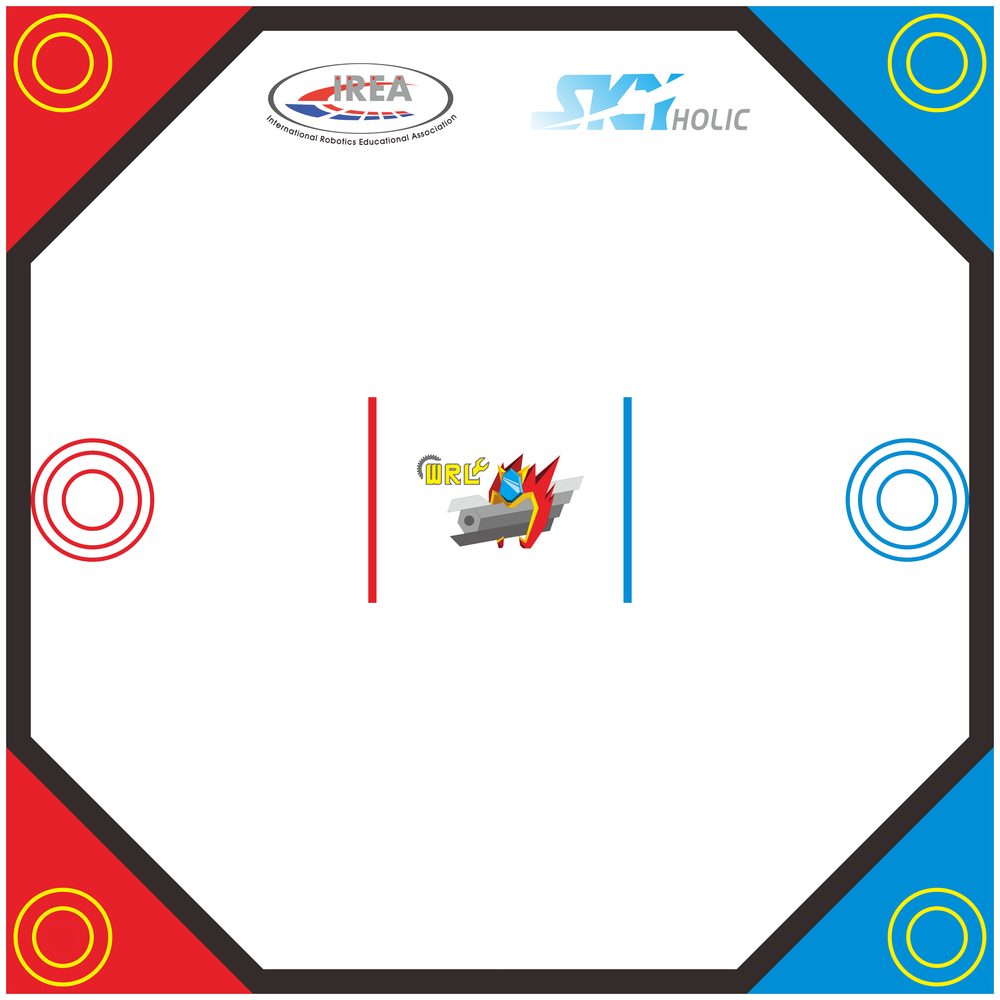
Bantamweight · Featherweight120 × 120 × 10–30 cm (±5%)PET or Flex
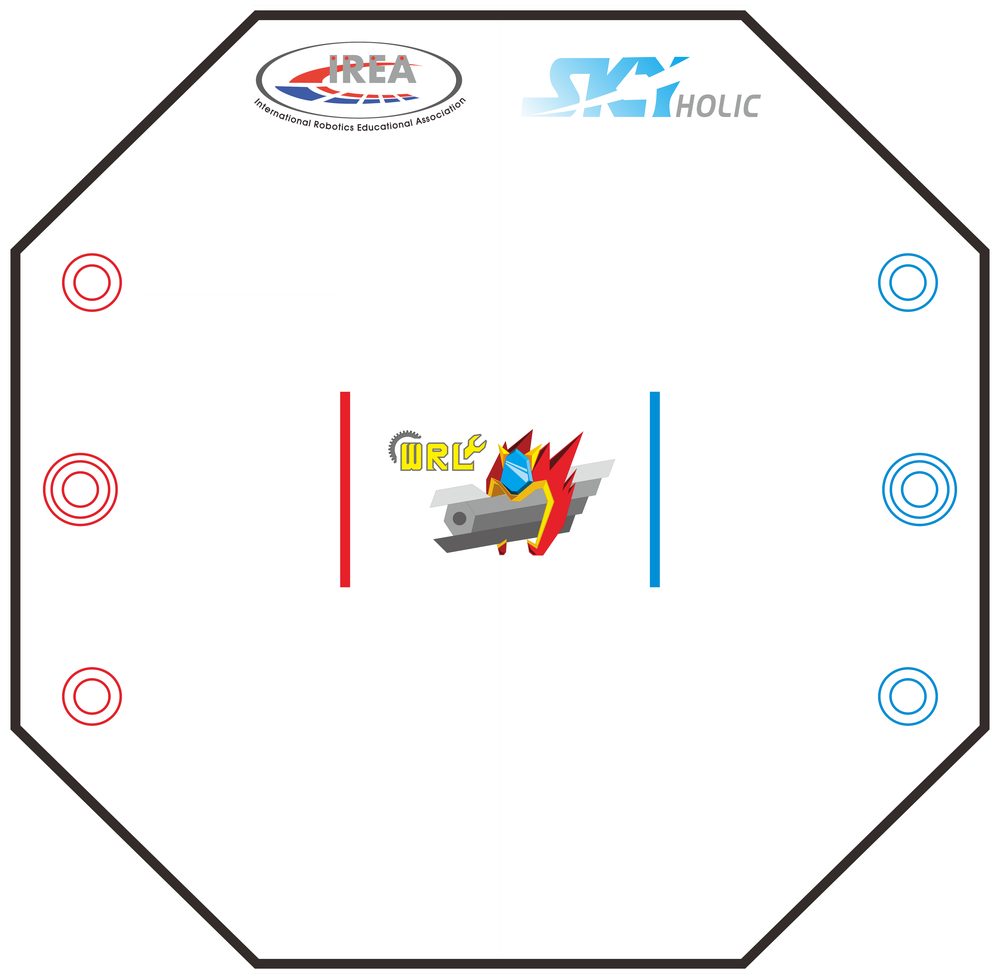
Lightweight · Middleweight · Heavyweight · PairApprox. 198 × 198 × 30 cm (±5%)Flex or PET
Fig. ❷ Flyweight class arena.
Fig. ❸ Bantamweight and Featherweight class arena.
Fig. ❹ Middleweight and Heavyweight class arena.
7-1-2Starting position — robots start behind the double parallel lines ("11-shaped lines") at the centre of the arena, facing the opposing robot.

The large arena consists of 5 square coated plywood panels measuring 70 × 70 cm (22T) and 4 triangular coated plywood panels measuring 70 × 70 cm (22T).

※ The regulations for this competition may be subject to future revisions. Please check periodically for updates.

Inquiries

Please send inquiries to robot-league@naver.com or contact the association representative, Daewon LEE, on WhatsApp at +82 10 2604 3782.

공식 경기 규정

휴머노이드 배틀 — 공식 규정

1:1 휴머노이드 로봇 토너먼트 — 유효한 기술로 상대 로봇을 넘어뜨리거나 장외로 밀어내 득점합니다. 리그는 연령과 체급에 따라 나뉩니다.

📄 공식 규정 원문 PDF (영문)🗓 개정판: Ver 25.06.30📑 국문 규정 원문 (HWP)

규정 검증 — IREA 심판위원장 박상복

Humanoid Battle — Official Rules

1개요

"휴머노이드 배틀"은 휴머노이드 로봇을 다양하게 활용하는 종목으로, 스포츠맨십과 상대에 대한 존중, 축제 분위기 속에서의 기술 교류를 중시합니다. 참가자가 휴머노이드 로봇을 조종해 유효한 기술로 상대 로봇을 넘어뜨리거나 경기장 밖으로 밀어내 득점하는 1:1 토너먼트 방식이며, 연령과 로봇 체급에 따라 리그를 나누어 경쟁합니다.

※ 대회 당일 참가 인원에 따라 토너먼트 방식은 변경될 수 있습니다. 모든 경기 종료 후 단체 럼블전이나 이벤트 경기가 진행될 수 있습니다.
※ 모든 대회에서 전 체급이 열리는 것은 아니며, 대회별로 일부 체급만 운영됩니다. 각 대회의 운영 체급은 포스터와 공지사항을 확인해 주세요.

2참가 부문

2-1. 리그 구분 (연령)

체급주니어시니어프로
미니멈급7~15세
플라이급7~12세13~18세
밴텀급7~12세13~18세
페더급7~12세13세~성인
라이트급7~12세13세~성인
미들급7세~성인
헤비급7세~성인

2-2. 체급 구분

체급체급 기준
미니멈급시판 제품 및 자작 로봇 0.7kg 미만
플라이급시판 제품 및 자작 로봇 1.0kg 미만 + 미니멈급 표준 로봇
밴텀급시판 제품 및 자작 로봇 1.5kg 미만 + 플라이급 표준 로봇
페더급시판 제품 및 자작 로봇 1.7kg 미만 + 밴텀급 표준 로봇
라이트급시판 제품 및 자작 로봇 2.0kg 미만 + 페더급 표준 로봇
미들급시판 제품 및 자작 로봇 2.7kg 이하 + 라이트급 표준 로봇
헤비급자작 로봇 3.5kg 미만 및 미들급 로봇 + 미들급 표준 로봇
2-2-1로봇 규격의 중량 허용 오차는 최대 +3g입니다.
2-2-2자발적 참가 또는 중복 참가를 조건으로, 현재 체급의 로봇 규격을 유지한 채 한 단계 높은 체급에 출전할 수 있습니다.

3로봇 규격

3-1로봇 기본 플랫폼 — 머리·몸통·팔·다리를 갖춘 인간형 구조이면서 로봇 규격 규정을 준수하는 휴머노이드 로봇만 출전할 수 있습니다.
로봇 규격의 길이 초과 허용 오차는 최대 +1mm입니다.
3-2-1기본 자세 — "검차 자세 신장"은 로봇을 완전히 편 상태에서, "기본 자세 신장"은 무릎 각도가 90° 이상인 상태에서 측정합니다. 기본 자세 신장은 지면에서부터 머리 또는 가슴의 축 중 가장 높은 부위까지 측정합니다. 모든 보행·공격 동작 중 로봇은 항상 기본 자세의 신장 기준을 유지해야 합니다. "기본 자세(Basic Stance)"란 무릎의 각도와 상·하체의 정렬 상태를 말합니다.
체급기본 자세 신장 기준
미니멈급200mm 이상
플라이급200mm 이상
밴텀급300mm 이상
페더급300mm 이상
라이트급300mm 이상
미들급350mm 이상
헤비급400mm 이상
그림 ❶ "기본 자세" — 무릎의 각도와 상·하체의 정렬 상태로, 90도 이상을 유지해야 합니다.
3-2-2그 외 모든 로봇 규격은 휴머노이드 표준 규정에 따라 제작해야 합니다.

4경기 규칙

4-1. 경기 방식

4-1-1제한 시간 3분(연장전 1분) 동안 상대에게 더 많은 "다운"을 얻은 참가자가 판정승을 거둡니다.
4-1-25다운을 얻으면 "TKO 승"이 선언되고 경기가 종료됩니다.
4-1-3"슬립 다운" 또는 "다운" 발생 후 10카운트 이내에 기본 자세로 복귀하지 못하면 "KO 패"가 선언되고 경기가 종료됩니다.
4-1-4"실격패", "기권패" 등이 선언되면 경기가 종료됩니다.

4-2. "다운" 규정

4-2-1"다운"의 기준과 판정은 전적으로 심판의 절대적 권한에 속합니다.
4-2-2정확한 타격으로 상대 로봇을 넘어뜨리면 1점("다운")을 얻습니다.
4-2-3"다운" 선언 후 카운트 중인 상대 로봇을 건드리면 다운 규정 위반으로 "실격패" 처리됩니다.
4-2-4참가자별 첫 경고는 구두 경고로 처리되며, 이후 경고가 1회 누적될 때마다 1다운 페널티가 부과됩니다.

4-3. "슬립 다운" 규정

4-3-1경기 중 발바닥(발 측면 포함)을 제외한 로봇의 어떤 부위도 경기장 바닥에 닿아서는 안 됩니다. 위반 시 "슬립 다운"이 선언되며, 고의적인 슬립 다운은 경고를 받을 수 있습니다. 단, "크리티컬 어택"은 이 규정에서 제외됩니다.
4-3-2공격 로봇이 "다운"을 성공시킨 후 "슬립 다운" 판정을 받으면, 해당 다운은 인정되지 않습니다.

4-4. "링 아웃" 규정

4-4-1로봇이 경기 구역 밖으로 떨어지거나 벗어나면 "링 아웃"이 선언되고 1다운 페널티가 부과됩니다.
4-4-2"링 아웃" 선언 전에 장외로 떨어지려는 로봇을 참가자가 만지는 경우에도 1다운 페널티가 부과됩니다.

4-5. "타임" 규정

4-5-1경기 중 규정 위반 상황이나 로봇 고장·문제 발생 시 심판에게 "타임아웃"을 요청할 수 있습니다. 수리 시간은 2분이 주어지며, 2분 타임아웃마다 1다운으로 계산됩니다.
4-5-2슬립 다운이 아닌 "다운"이 선언된 후에는 타임아웃 요청이 받아들여지지 않으며, 카운트와 경기는 그대로 진행됩니다.
4-5-3중요한 문의나 이의 제기를 위한 타임아웃 요청에는 1다운 페널티가 부과되지 않습니다. 단, 심판이 타당하지 않은 요청으로 판단하면 경고가 주어질 수 있습니다.
4-5-4타임아웃은 경기당 최대 2회, 총 4분까지 요청할 수 있습니다. 주어진 시간 내에 경기에 복귀하지 못하면 KO 패로 선언됩니다.

4-6. 스탠딩 다운 규정

4-6-1로봇이 5초 이상 움직이지 않으면 심판은 "스탠딩 다운"을 선언할 수 있습니다. 스탠딩 다운 시 1다운 페널티가 부과되며, 선언 후 10카운트 이내에 복귀하지 못하면 "KO 패"가 선언됩니다.
4-6-2"스탠딩 다운"이 선언된 참가자는 타임아웃을 요청할 수 있으며, 2분의 수리 시간이 주어집니다. 이때 추가로 1다운 페널티가 부과됩니다.

4-7. KO(녹아웃) 규정

4-7-1"스탠딩 다운", "슬립 다운", "다운"이 선언되면 참가자는 10카운트 이내에 로봇을 일으켜야 합니다. 기본 자세로 복귀하지 못하면 "KO 패"가 선언되고 경기가 종료됩니다.
4-7-210카운트가 반드시 초당 1카운트를 의미하지는 않습니다. 카운트 속도는 경기 흐름과 상황에 따라 심판 재량으로 정해집니다.

4-8. "수비 자세" 규정

4-8-1보행·공격 중 기본 자세는 항상 무릎 각도(무릎 관절에서 허벅지와 종아리 사이 각도)를 90도 이상으로 유지해야 합니다. 그 미만의 각도는 "수비 자세"로 간주됩니다.
4-8-2어깨 축이 골반 축보다 낮아지는 경우에도 "수비 자세"로 판정됩니다.
4-8-3수비 자세를 3초 이상 유지하거나 주저앉는 행위는 허용되지 않습니다. 수비 자세 해제 후에는 3보 이상 보행해야 합니다. 이를 지키지 않으면 경고가 주어집니다. 이 규정은 크리티컬 어택에도 적용됩니다.
4-8-4수비 자세에서는 공격에 성공하더라도 "다운"으로 인정되지 않으며 경고가 주어집니다. 단, 크리티컬 어택은 예외입니다.

4-9 & 4-10. 공격·정면 공격 규정

4-9-1공격 시 "슬립 다운"에 해당하거나 "수비 자세"에서 행하는 공격을 제외한 모든 공격이 허용되며, 전 방향(360°) 공격이 가능합니다.
4-10-1공격 로봇이 정면 공격으로 두 다리 사이에서 미는 공격을 통해 상대 로봇의 상체(머리·가슴·등)를 정확히 타격하여 상대를 앞뒤로 넘어뜨리면 "정면 공격"으로 인정되어 2다운이 부과됩니다.
4-10-2정면 공격 성공 후 공격 로봇이 "슬립 다운"되면 해당 공격은 인정되지 않습니다.
4-10-3정면 공격의 시도 및 성공 여부 판정 권한은 심판에게 있습니다. 정면 공격의 횟수에는 제한이 없습니다. (4-10-4)

4-11. 크리티컬 어택 규정

4-11-1상대 로봇의 두 발이 지면에서 완전히 떨어지게 하여 넘어뜨리는 강력한 공격이나 발차기 기술은 "크리티컬 어택"으로 인정되어 2다운이 부과됩니다.
4-11-2"크리티컬 어택"이란 돌진, 스윕(다리 걸기), 백드롭, 어퍼컷, 날아차기, 발차기, 텀블링 등 상대에게 큰 충격을 주는 기술을 말합니다. 크리티컬 어택의 시도 및 성공 판정 권한은 심판에게 있습니다.
4-11-3심판 판단에 따라, 상대 로봇을 완전히 제압하고 두 발을 지면에서 완전히 들어 올리는 공격에 성공한 경우, 공격 로봇이 이후 "슬립 다운"되더라도 크리티컬 어택 성공으로 인정됩니다.
4-11-4"발차기" 공격은 수비 자세에서도 시도할 수 있으며, 발차기로 상대를 넘어뜨린 후 슬립 다운되더라도 크리티컬 어택 성공으로 인정됩니다. 발차기는 한 손이 지면에 닿은 상태에서도 시도할 수 있습니다. (4-11-5)
4-11-6크리티컬 어택은 경기당 총 1회로 제한됩니다. 단, 발차기 공격은 크리티컬 어택과 별도로 1회 추가 시도할 수 있습니다. 연장전에서도 크리티컬 어택은 1회로 제한됩니다. 이번 경기에서 크리티컬 어택을 사용했더라도 다음 경기에서 다시 시도할 수 있습니다. 성공 가능성이 없는 무리한 시도나 허용 횟수를 초과한 시도는 경기 지연으로 간주되어 경고를 받습니다. (4-11-7)

4-12. 보행 규정

4-12-1보행 중 수비 자세를 유지하는 것은 허용되지 않으며, 위반할 때마다 경고가 주어집니다. 모든 보행이 규정을 위반한다고 판단되면 2분의 수정 시간이 주어지고 1다운으로 계산됩니다. 수정이 불가능한 경우 "실격패" 처리됩니다.
4-12-2로봇은 전·후·좌·우 중 최소 두 방향으로 각각 5보 이상 넘어지지 않고 보행할 수 있어야 합니다. 심판은 경기 전후·도중 언제든 검증을 요청할 수 있으며, 이 테스트를 통과하지 못한 로봇은 보행 규정 위반으로 실격 처리됩니다.
4-12-3보행·공격·방어 중 인정된 발바닥을 제외한 로봇의 어떤 부위라도 경기장에 닿으면 즉시 "슬립 다운" 또는 "다운"으로 처리됩니다.
4-12-4보행 및 방향 전환 시 양쪽 어깨 축과 가슴 축은 항상 경기장 표면과 수평을 유지해야 합니다. 수평을 유지하지 못하는 보행 동작은 "수비 자세"로 판정되어 경고가 주어집니다. 가슴 축의 수평 허용 오차는 ±10도까지입니다.

4-13. 기타 규정

4-13-1경기 시작 시 또는 "슬립 다운"·"다운" 후 재개 시, 로봇 간 거리는 최소 50cm(약 두 뼘)를 유지해야 합니다. 고의로 이를 위반하면 경고를 받습니다. 단, 페더급 이하 체급의 최소 거리는 20cm(약 한 뼘)입니다.
4-13-2넘어진 로봇은 공격할 수 없습니다. 위반 시 경고가 주어집니다.
4-13-3경기 중 한 변의 길이가 3cm 이상이거나 무게 5g 이상인 부품이 떨어지거나, 배터리가 이탈해 로봇 밖으로 조금이라도 튀어나오면 경기가 즉시 중단되고 2분의 수리 시간이 주어지며 1다운으로 계산됩니다. 정상적인 수리가 불가능하면 "TKO 패"로 처리됩니다.
4-13-4경기 중 심판의 허가 없이 로봇을 만질 수 없습니다. 위반 시 심판 재량에 따라 경고, 다운 또는 실격 처리될 수 있습니다.
4-13-5경기 중 수비 위주의 전략을 사용하는 경우 심판 재량으로 경고가 주어질 수 있습니다.
4-13-6경기 중 심판이 "스톱"을 선언하면 로봇은 즉시 동작을 멈춰야 합니다. 위반 시 경고가 주어집니다.
4-13-7로봇이 서로 엉킨 경우 심판은 "토크 오프"를 선언할 수 있으며, 참가자는 즉시 모터 전원을 차단해야 합니다.
4-13-8심판의 오심이나 판정에 따라, 경기 종료 후라도 승패 선언이 번복되거나 경기가 재개될 수 있습니다.
4-13-9참가자 또는 소속 관계자가 심판 고유 권한인 판정에 불복하거나, 존중이 결여된 태도를 보이거나, 과도하게 항의하는 경우 1차 경고가 주어집니다. 불복과 항의가 반복되면 즉시 실격 처리됩니다.
4-13-10경기 중이나 경기 중단 시 심판이 판정·규정에 대해 설명할 때, 참가자는 "네"라고 답하고 가볍게 고개를 끄덕여 이해했음을 표시해야 합니다.

4-14. 용어 규정

경기 중에는 아래 용어가 사용됩니다. 상황에 따른 용어를 미리 숙지해 주세요.

레디 · Ready파이트 · Fight다운 · Down노카운트 · No-Count스탠딩다운 · Standing-down링 아웃 · Ring-out토크오프 · Torque-Off떨어져 · Distance경고 · Yellow-Card타임 · Time스톱 · Stop그만 · Game-Over승 · Win차렷 · Attention인사 · Bow디스퀄리피 · Disqualify득점 · Point정면공격 · Frontal Attack
4-14-2규정에 명시되지 않은 사항은 대회 당일 심판위원회의 결정에 따릅니다.

5로봇 개조·수정

5-1-1규격 검차 완료 후 이상이나 기타 사유로 로봇 수정이 필요한 경우, 반드시 심판의 허가를 받은 후 변경해야 합니다(경기 중에는 1다운으로 계산). 허가 없이 변경하면 실격 처리됩니다.

6평가 방법

6-1. 기본 평가

6-1-1규정을 준수하며 제한 시간 내에 상대에게 KO, TKO, 판정승, (상대의) 실격, 기권 등의 결과를 얻은 참가자가 승리합니다.
6-1-2상황에 따라 여러 로봇이 참가하는 단체전인 "럼블" 경기로 순위를 결정할 수 있습니다. 럼블 경기에서는 넘어진 로봇도 공격할 수 있습니다. "링 아웃"되거나 "다운"된 참가자는 즉시 탈락하며, 최종적으로 경기장에 남아 있거나 "미션 오브젝트"를 제거한 로봇이 승리합니다.

6-2. 무승부 평가

6-2-1동점일 경우 배터리 교체나 수리를 위한 추가 시간 없이 즉시 1분 연장전에 돌입합니다. 먼저 1점을 얻는 팀이 "골든 다운"으로 승리합니다. 득점으로 계산되지 않은 잔여 경고는 연장전으로 이월됩니다.
6-2-2연장전 후에도 승부가 나지 않으면 다음 우선순위로 평가합니다: 경고가 적은 팀 → 연장전 중 슬립 다운이 적은 팀 → 그래도 가려지지 않으면 추가 연장전 진행 가능 → 로봇 중량이 더 가벼운 팀. 연장전 이후에도 동점인 경우 이 기준에 따라 승패를 결정합니다.

6-3. 실격 규정

6-3-1다른 참가자의 로봇으로 경기에 참가하는 경우.
6-3-2심판의 지시나 판정에 따르지 않는 경우.
6-3-3경기 중 로봇 규격을 위반한 경우.
6-3-4심판의 허가 없이 경기장 또는 지정 대기 구역을 이탈하는 경우.
6-3-5욕설을 하거나 폭력적인 행동을 하는 경우.
6-3-6비신사적인 행동이나 경기 진행을 방해하는 행위를 하는 경우.
6-3-7다른 모든 경기가 끝난 후에도 경기에 참가하지 못하는 경우.
6-3-8실격된 참가자의 해당 경기 기록은 인정되지 않습니다.
6-3-9참가 팀 또는 개인이 실격되거나 고의로 공정성을 훼손한 경우, IREA는 심의 협의회를 거쳐 IREA 공인 대회 참가 자격을 영구적으로 박탈할 수 있습니다.

7경기장 규격

아래는 경기장 규격입니다. 배치는 예시이며 대회 당일 여건에 따라 변경될 수 있습니다.

체급경기장 크기 (가로 × 세로 × 높이)바닥 소재
미니멈급 · 플라이급90 × 90 × 10 cm (±5%)PET
밴텀급 · 페더급120 × 120 × 10~30 cm (±5%)PET 또는 플렉스
라이트급 · 미들급 · 헤비급 · 페어약 198 × 198 × 30 cm (±5%)플렉스 또는 PET
그림 ❷ 플라이급 경기장.
그림 ❸ 밴텀급·페더급 경기장.
그림 ❹ 미들급·헤비급 경기장.
7-1-2로봇 시작 위치 — 로봇은 경기장 가운데의 "11자 라인" 뒤에서 상대 로봇을 바라보고 시작합니다.

대형 경기장은 70 × 70 cm(22T) 정사각형 코팅 합판 5장과 70 × 70 cm(22T) 삼각형 코팅 합판 4장으로 구성됩니다.

※ 본 대회 규정은 향후 개정될 수 있습니다. 수시로 업데이트를 확인해 주세요.

문의

문의는 robot-league@naver.com 또는 협회 대표 이대원(WhatsApp +82 10 2604 3782)에게 연락해 주세요.

官方競賽規則

人形機器人格鬥 — 官方規則

一對一人形機器人淘汰賽 — 以有效技術擊倒對方機器人或將其推出場外得分。聯賽依年齡與量級劃分。

📄 官方PDF原文(英文)🗓 修訂版:Ver 25.06.30📑 韓文原文(HWP)

規則審定 — IREA 首席裁判 朴相福(Sangbok Park)

Humanoid Battle — Official Rules

1總則

「人形機器人格鬥」是一項多元運用人形機器人的競賽,強調運動家精神、尊重對手,並在歡樂的氛圍中交流技術。本項目為一對一淘汰賽,參賽者操控人形機器人,以有效技術擊倒對方機器人或將其推出場外得分。依參賽者年齡與機器人量級分組競賽。

※ 賽制可能依當日參賽人數而調整。所有比賽結束後,可能舉行團體混戰或表演賽。
※ 並非每場比賽都開放所有量級,各賽事僅開放部分量級。請查看海報與公告確認各賽事的量級。

2參賽組別

2-1. 聯賽組別(年齡)

量級青少年組 Junior青年組 Senior職業組 Pro
迷你量級7~15歲
蠅量級7~12歲13~18歲
雛量級7~12歲13~18歲
羽量級7~12歲13歲~成人
輕量級7~12歲13歲~成人
中量級7歲~成人
重量級7歲~成人

2-2. 量級劃分

量級量級標準
迷你量級市售產品及自製機器人 0.7kg 以下
蠅量級市售產品及自製機器人 1.0kg 以下 + 迷你量級標準機器人
雛量級市售產品及自製機器人 1.5kg 以下 + 蠅量級標準機器人
羽量級市售產品及自製機器人 1.7kg 以下 + 雛量級標準機器人
輕量級市售產品及自製機器人 2.0kg 以下 + 羽量級標準機器人
中量級市售產品及自製機器人 2.7kg 以下 + 輕量級標準機器人
重量級自製機器人 3.5kg 以下及中量級機器人 + 中量級標準機器人
2-2-1機體規格的重量允許誤差最大為 +3g
2-2-2在自願或重複參賽的前提下,參賽者可維持原量級的機體規格,參加高一級量級的比賽。

3機體規格

3-1機體基本平台 — 僅具有頭部、軀幹、手臂與腿部之類人結構,且符合機體規格規定的人形機器人方可參賽。
機體規格的長度允許超出誤差最大為 +1mm
3-2-1基本姿勢 — 「檢錄姿勢身高」在機器人完全伸展時測量;「基本姿勢身高」在膝關節角度 90° 以上時測量。基本姿勢身高自地面測量至頭部或胸部軸中最高的部位。所有行走與攻擊過程中,機器人必須始終維持基本姿勢的身高標準。「基本站姿」是指膝蓋角度及上下身的對齊狀態。
量級基本姿勢身高標準
迷你量級200mm 以上
蠅量級200mm 以上
雛量級300mm 以上
羽量級300mm 以上
輕量級300mm 以上
中量級350mm 以上
重量級400mm 以上
圖 ❶「基本站姿」— 膝蓋角度與上下身的對齊狀態,須維持 90 度以上。
3-2-2其他所有機體規格均須依照人形機器人標準規範製作。

4比賽規則

4-1. 比賽方式

4-1-13 分鐘(延長賽 1 分鐘)的時限內,取得較多「擊倒(Down)」的參賽者獲判定勝。
4-1-2取得 5 次擊倒即宣告「TKO 勝」,比賽結束。
4-1-3發生「滑倒(Slip Down)」或「擊倒」後,若無法在 10 秒讀秒內恢復基本站姿,即宣告「KO 敗」,比賽結束。
4-1-4若宣告「失格敗」、「棄權敗」等,比賽即結束。

4-2. 「擊倒」規定

4-2-1「擊倒」的標準與判定完全屬於裁判的絕對權限。
4-2-2以精準打擊擊倒對方機器人,可獲得 1 分(「擊倒」)。
4-2-3「擊倒」宣告後,若在讀秒期間觸碰被讀秒的機器人,視為違反擊倒規定,判「失格敗」。
4-2-4每位參賽者的首次警告為口頭警告;此後每累積 1 次警告,即處以 1 次擊倒的處罰。

4-3. 「滑倒」規定

4-3-1比賽中,除腳底(含腳側)外,機器人任何部位不得接觸場地地面。違者宣告「滑倒」,蓄意滑倒可能受到警告。惟「致命攻擊」不受此規定限制。
4-3-2若攻擊方機器人在成功「擊倒」後被判「滑倒」,該次擊倒不予承認。

4-4. 「出界」規定

4-4-1若機器人跌出或離開比賽區域,宣告「出界」,並處以 1 次擊倒的處罰。
4-4-2在宣告「出界」前,若參賽者觸碰即將跌出場外的機器人,仍處以 1 次擊倒的處罰。

4-5. 「暫停」規定

4-5-1比賽中,若發生違規情況或機器人故障、問題,參賽者可向裁判請求「暫停」。維修時間為 2 分鐘,每次 2 分鐘暫停計為 1 次擊倒。
4-5-2一旦宣告「擊倒」(非滑倒),將不受理暫停請求,讀秒與比賽照常進行。
4-5-3因重要詢問或提出異議而請求的暫停,不處以擊倒處罰。惟若裁判認定請求不當,可給予警告。
4-5-4每場比賽最多可請求 2 次暫停,共計 4 分鐘。若在允許時間內無法重返比賽,將被判 KO 敗。

4-6. 站立擊倒規定

4-6-1若機器人靜止 5 秒以上,裁判可宣告「站立擊倒」。站立擊倒處以 1 次擊倒處罰,且宣告後若未能在 10 秒讀秒內恢復,將判「KO 敗」。
4-6-2被宣告「站立擊倒」的參賽者可請求暫停,獲得 2 分鐘維修時間,並額外處以 1 次擊倒處罰。

4-7. KO(擊倒獲勝)規定

4-7-1宣告「站立擊倒」、「滑倒」或「擊倒」後,參賽者必須在 10 秒讀秒內使機器人站起。若無法恢復基本站姿,即判「KO 敗」,比賽結束。
4-7-210 秒讀秒不一定是每秒讀一次。讀秒速度由裁判依比賽節奏與現場情況酌定。

4-8. 「防禦姿勢」規定

4-8-1行走與攻擊時,基本站姿必須始終保持膝關節角度(大腿與小腿在膝關節處的夾角)至少 90 度。小於此角度視為「防禦姿勢」。
4-8-2若肩軸低於髖軸,亦判定為「防禦姿勢」。
4-8-3不得維持防禦姿勢超過 3 秒或坐下。解除防禦姿勢後,須行走 3 步以上。違者將受警告。此規定亦適用於致命攻擊。
4-8-4在防禦姿勢下,即使攻擊成功也不承認為「擊倒」,並將給予警告。惟致命攻擊為例外。

4-9 & 4-10. 攻擊與正面攻擊規定

4-9-1攻擊時,除構成「滑倒」或在「防禦姿勢」下進行的攻擊外,允許所有攻擊,包括全方位(360°)攻擊。
4-10-1若攻擊方機器人以正面攻擊方式,在雙腿之間以推擊準確打擊對方機器人上身(頭、胸、背),使其向前或向後倒下,即承認為「正面攻擊」,處以 2 次擊倒
4-10-2若攻擊方機器人在成功正面攻擊後發生「滑倒」,該攻擊不予承認。
4-10-3正面攻擊的嘗試與成功與否由裁判判定。正面攻擊次數不受限制。(4-10-4)

4-11. 致命攻擊規定

4-11-1若機器人施展強力攻擊或踢技,使對方機器人雙腳明顯離地並倒下,即承認為「致命攻擊」,處以 2 次擊倒
4-11-2「致命攻擊」是指衝撞、掃腿、後摔、上勾拳、飛踢、踢擊、翻滾等對對手造成重大衝擊的技術。致命攻擊的嘗試與成功與否由裁判判定。
4-11-3經裁判判定,若機器人成功施展完全制伏對方機器人並使其雙腳完全離地的攻擊,即使攻擊方其後發生「滑倒」,該攻擊仍視為成功的致命攻擊。
4-11-4「踢擊」攻擊即使在防禦姿勢下也可嘗試;若以踢擊擊倒對手後發生滑倒,該攻擊仍視為成功的致命攻擊。單手觸地時亦可嘗試踢擊。(4-11-5)
4-11-6致命攻擊每場比賽限用 1 次。惟踢擊攻擊可在致命攻擊之外額外嘗試 1 次。延長賽中致命攻擊亦限 1 次。即使本場比賽已使用致命攻擊,下一場比賽仍可再次嘗試。毫無成功可能的無理嘗試或超出允許次數的嘗試,將視為拖延比賽並予以警告。(4-11-7)

4-12. 行走規定

4-12-1行走時不得維持防禦姿勢,每次違規均予警告。若判定所有行走動作均違規,將給予 2 分鐘修正時間並計為 1 次擊倒。無法修正者判「失格敗」。
4-12-2機器人必須能在前、後、左、右至少兩個方向各行走 5 步以上而不跌倒。裁判可在賽前或比賽中隨時要求驗證,未通過測試的機器人將因違反行走規定被取消資格。
4-12-3行走、攻擊或防守時,除認可的腳底外,機器人任何部位觸及場地,將立即判為「滑倒」或「擊倒」。
4-12-4行走與轉向時,雙肩軸與胸軸必須始終與場地表面保持水平。未能保持水平的行走動作將判為「防禦姿勢」並予警告。胸軸與水平的允許偏差為 ±10 度。

4-13. 其他規定

4-13-1開賽或「滑倒」、「擊倒」後恢復比賽時,機器人之間必須保持至少 50cm(約兩掌距)的距離。蓄意違反者將受警告。惟羽量級及以下量級的最小距離為 20cm(約一掌距)。
4-13-2不得攻擊已倒下的機器人。違者將受警告。
4-13-3比賽中若邊長 3cm 以上或重量 5g 以上的零件脫落,或電池脫離並稍微凸出機器人外,比賽將立即中止並給予 2 分鐘維修時間,計為 1 次擊倒。若無法正常修復,判「TKO 敗」。
4-13-4比賽中未經裁判許可不得觸碰機器人。違者由裁判酌情處以警告、擊倒或取消資格。
4-13-5比賽中若採取消極防守策略,裁判可酌情給予警告。
4-13-6比賽中裁判示意「停止」時,機器人必須立即停止動作。違者將受警告。
4-13-7若機器人相互纏繞,裁判可宣告「扭力關閉(Torque-Off)」,參賽者必須立即切斷馬達電源。
4-13-8因裁判失誤或裁定,即使比賽已結束,勝負宣告仍可能被推翻並恢復比賽。
4-13-9若參賽者或其相關人員不服裁判(裁判專屬權限)的判定、表現出不尊重的態度或過度抗議,將先予警告。若持續不服從並反覆抗議,將立即取消資格。
4-13-10比賽中或暫停時,當裁判就判定或規則進行說明,參賽者應回答「是」並輕輕點頭表示理解。

4-14. 術語規定

比賽中將使用以下術語(韓語裁判口令及其含義)。請參賽者事先熟悉這些術語。

레디 · Ready파이트 · Fight다운 · Down노카운트 · No-Count스탠딩다운 · Standing-down링 아웃 · Ring-out토크오프 · Torque-Off떨어져 · Distance경고 · Yellow-Card타임 · Time스톱 · Stop그만 · Game-Over승 · Win차렷 · Attention인사 · Bow디스퀄리피 · Disqualify득점 · Point정면공격 · Frontal Attack
4-14-2本規則未明定之事項,依比賽當日裁判委員會之決定辦理。

5機體改裝與修改

5-1-1完成規格檢錄後,若因異常或其他原因需修改機器人,必須先取得裁判許可方可變更(比賽中計為 1 次擊倒)。未經許可擅自變更者將被取消資格。

6評分方式

6-1. 基本評分

6-1-1遵守既定規則,並在規定時間內對對手取得 KO、TKO、判定勝、(對方)失格或棄權等結果的參賽者獲勝。
6-1-2視情況而定,可由多台機器人參加名為「混戰(Rumble)」的團體賽以決定名次。混戰中,已倒下的機器人也可被攻擊。「出界」或「擊倒」的參賽者立即淘汰,最終留在場上或移除「任務物件」的機器人獲勝。

6-2. 平局評分

6-2-1若比分相同,將立即進入 1 分鐘延長賽,不另給更換電池或維修時間。先得 1 分的隊伍以「黃金擊倒(Golden Down)」獲勝。未計入得分的剩餘警告將帶入延長賽。
6-2-2若延長賽後仍未分出勝負,依下列優先順序評定:警告較少的隊伍 → 延長賽中滑倒較少的隊伍 → 若仍無法判定,可再進行延長賽 → 機器人重量較輕的隊伍。延長賽後仍平手時,依上述標準決定勝負。

6-3. 取消資格規定

6-3-1使用其他參賽者的機器人參賽。
6-3-2拒絕服從裁判的指示或判定。
6-3-3比賽中違反機體規格。
6-3-4未經裁判許可離開場地或指定等候區。
6-3-5使用粗言穢語或有暴力行為。
6-3-6有任何違反運動精神或妨礙比賽進行的行為。
6-3-7在其他所有比賽結束後仍無法出賽。
6-3-8被取消資格者,該場比賽紀錄不予承認。
6-3-9若參賽隊伍或個人被取消資格,或蓄意破壞公平性,IREA 可經審議會議永久取消其參加 IREA 認可賽事的資格。

7場地規格

以下為場地規格。佈局僅為範例,可能依比賽當日情況調整。

量級場地尺寸(寬 × 長 × 高)地面材質
迷你量級 · 蠅量級90 × 90 × 10 cm(±5%)PET
雛量級 · 羽量級120 × 120 × 10–30 cm(±5%)PET 或 Flex
輕量級 · 中量級 · 重量級 · 雙人約 198 × 198 × 30 cm(±5%)Flex 或 PET
圖 ❷ 蠅量級場地。
圖 ❸ 雛量級與羽量級場地。
圖 ❹ 中量級與重量級場地。
7-1-2起始位置 — 機器人於場地中央「11 字線」後方,面向對方機器人開始比賽。

大型場地由 5 塊 70 × 70 cm(22T)方形塗層合板與 4 塊 70 × 70 cm(22T)三角形塗層合板組成。

※ 本競賽規則日後可能修訂,請定期查看最新版本。

洽詢

如有疑問,請寄信至 robot-league@naver.com,或透過 WhatsApp +82 10 2604 3782 聯繫協會代表 Daewon LEE。

Reglamento oficial de competición

Humanoid Battle — Reglamento oficial

Un torneo de robots humanoides uno contra uno: gane puntos con técnicas válidas que derriben al robot rival o lo empujen fuera de la arena. Las ligas se dividen por edad y categoría de peso.

📄 PDF oficial (inglés)🗓 Revisión: Ver 25.06.30📑 Original en coreano (HWP)

Verificación del reglamento — Sangbok Park, Juez Principal de IREA

Humanoid Battle — Official Rules

1Descripción general

"Humanoid Battle" es una competición que implica el uso diverso de robots humanoides, con énfasis en la deportividad, el respeto al rival y el intercambio técnico en un ambiente festivo. Es un torneo uno contra uno donde los participantes controlan robots humanoides para ganar puntos con técnicas válidas que derriben al robot rival o lo empujen fuera de la arena. Se compite en ligas según la edad y la categoría de peso del robot.

※ El formato del torneo puede cambiar según el número de participantes el día de la competición. Al concluir todos los combates, pueden celebrarse rumbles grupales y combates de exhibición.
※ No todas las categorías de peso están abiertas en cada competición; consulte los carteles y anuncios para confirmar las categorías de cada evento.

2Categorías de participación

2-1. Categorías de liga (edad)

CategoríaJuniorSeniorPro
Mínimo7~15 años
Peso mosca7~12 años13~18 años
Peso gallo7~12 años13~18 años
Peso pluma7~12 años13 años~adulto
Peso ligero7~12 años13 años~adulto
Peso medio7 años~adulto
Peso pesado7 años~adulto

2-2. Categorías de peso

CategoríaCategoría de peso
MínimoProductos comerciales y robots de fabricación propia de menos de 0,7 kg
Peso moscaProductos comerciales y robots propios de menos de 1,0 kg + robots estándar de la clase Mínimo
Peso galloProductos comerciales y robots propios de menos de 1,5 kg + robots estándar del peso mosca
Peso plumaProductos comerciales y robots propios de menos de 1,7 kg + robots estándar del peso gallo
Peso ligeroProductos comerciales y robots propios de menos de 2,0 kg + robots estándar del peso pluma
Peso medioProductos comerciales y robots propios de 2,7 kg o menos + robots estándar del peso ligero
Peso pesadoRobots de fabricación propia de menos de 3,5 kg y robots del peso medio + robots estándar del peso medio
2-2-1La especificación del robot permite una tolerancia de peso de hasta +3 g.
2-2-2Los participantes pueden competir en una categoría de peso un nivel superior a la suya, manteniendo las especificaciones de su categoría actual, en condición de participación voluntaria o simultánea.

3Especificaciones del robot

3-1Plataforma base del robot — solo pueden participar robots humanoides con estructura similar a la humana (cabeza, torso, brazos y piernas) que cumplan el reglamento de especificaciones.
Las especificaciones del robot permiten una tolerancia de longitud de hasta +1 mm.
3-2-1Postura básica — la "altura en postura de inspección" se mide con el robot completamente extendido, mientras que la "altura en postura básica" se mide con un ángulo de rodilla de 90° o más. La altura en postura básica se mide desde el suelo hasta el más alto de los ejes de la cabeza o el pecho. Durante toda la marcha y los ataques, el robot debe mantener siempre el límite de altura de la postura básica. La "postura básica" se refiere al ángulo de las rodillas y la alineación del cuerpo superior e inferior.
CategoríaLímite de altura en postura básica
Mínimo200mm o más
Peso mosca200mm o más
Peso gallo300mm o más
Peso pluma300mm o más
Peso ligero300mm o más
Peso medio350mm o más
Peso pesado400mm o más
Fig. ❶ "Postura básica": el ángulo de las rodillas y la alineación del cuerpo superior e inferior, manteniendo 90 grados o más.
3-2-2Todas las demás especificaciones del robot deben cumplir el Reglamento estándar de humanoides.

4Reglas del juego

4-1. Métodos de juego

4-1-1Dentro del límite de 3 minutos (1 minuto en la prórroga), gana por decisión el participante que obtenga más "caídas" (downs) del rival.
4-1-2Si se obtienen 5 caídas, se declara una "victoria por TKO" y el combate termina.
4-1-3Si ocurre un "slip down" o una "caída" y el participante no puede volver a la postura básica dentro de una cuenta de 10, se declara una "derrota por KO" y el combate termina.
4-1-4Si se declara una "derrota por descalificación", "derrota por abandono" o similar, el combate termina.

4-2. Reglas sobre la "caída" (down)

4-2-1Los criterios y el juicio sobre una "caída" corresponden exclusivamente a la autoridad absoluta del árbitro.
4-2-2Si el robot rival es derribado por un golpe preciso, se gana un punto ("caída").
4-2-3Si un robot toca al robot que está siendo contado tras declararse una "caída", se considera una infracción de la regla y resulta en "derrota por descalificación".
4-2-4La primera advertencia de cada participante es verbal; después, cada advertencia acumulada supone una penalización de una caída.

4-3. Regla del "slip down"

4-3-1Durante el combate, ninguna parte del robot excepto la planta del pie (incluidos los laterales del pie) debe tocar el suelo de la arena. La infracción supone la declaración de "slip down", y los slip downs intencionados pueden acarrear advertencia. Los "ataques críticos" están exentos de esta regla.
4-3-2Si el robot atacante es declarado en "slip down" tras lograr una "caída", la caída no será reconocida ni contada.

4-4. Regla del "ring out"

4-4-1Si un robot cae o sale del área de competición, se declara "ring out" y se penaliza con una caída.
4-4-2Si un participante toca un robot que está a punto de caer fuera del área antes de que se declare el "ring out", igualmente se penaliza con una caída.

4-5. Regulación del "tiempo"

4-5-1Durante el combate, los participantes pueden solicitar al árbitro un "tiempo muerto" en caso de infracciones o si su robot presenta averías o problemas. Se conceden 2 minutos de reparación, y cada tiempo muerto de 2 minutos cuenta como una caída.
4-5-2Una vez declarada una "caída" (que no sea slip down), no se aceptarán solicitudes de tiempo muerto, y la cuenta y el combate continuarán normalmente.
4-5-3Las solicitudes de tiempo muerto por consultas u objeciones importantes no acarrean penalización de caída. Sin embargo, si el árbitro determina que la solicitud no es válida, puede emitir una advertencia.
4-5-4Se pueden solicitar tiempos muertos un máximo de 2 veces por combate, con un total de 4 minutos. Si el participante no puede volver al combate tras ese tiempo, será declarado perdedor por KO.

4-6. Regla del "standing down"

4-6-1Si un robot permanece inactivo durante 5 segundos o más, el árbitro puede declarar un "standing down", que supone una penalización de una caída. Si el robot no se recupera dentro de la cuenta de 10 tras la declaración, se declarará "derrota por KO".
4-6-2Los participantes declarados en "standing down" pueden solicitar un tiempo muerto de 2 minutos para reparaciones, recibiendo además una penalización adicional de una caída.

4-7. Regla del KO

4-7-1Cuando se declara un "standing down", "slip down" o "caída", el participante debe levantarse dentro de una cuenta de 10. Si no puede volver a la postura básica, se declara "derrota por KO" y el combate termina.
4-7-2La cuenta de 10 no significa necesariamente un conteo por segundo. La velocidad del conteo queda a discreción del árbitro según el desarrollo del combate y la situación.

4-8. Regulaciones de la "postura defensiva"

4-8-1Durante la marcha y el ataque, la postura básica debe mantener siempre un ángulo de rodilla (entre el muslo y la pantorrilla) de al menos 90 grados. Ángulos menores se consideran "postura defensiva".
4-8-2Si el eje del hombro cae por debajo del eje de la cadera, también se juzga como "postura defensiva".
4-8-3No se permite mantener la postura defensiva durante más de 3 segundos ni sentarse. Tras abandonar la postura defensiva, se requiere caminar 3 pasos o más. El incumplimiento acarrea una advertencia. Esta regla también se aplica a los ataques críticos.
4-8-4En postura defensiva, aunque un ataque tenga éxito, no se reconocerá como "caída" y se emitirá una advertencia. Los ataques críticos son la excepción.

4-9 y 4-10. Ataques y ataque frontal

4-9-1Durante un ataque, se permiten todos los ataques excepto los considerados "slip downs" o los realizados en "postura defensiva", incluidos ataques desde todas las direcciones (360°).
4-10-1Si un robot atacante golpea con precisión el cuerpo superior (cabeza, pecho, espalda) del robot rival con un ataque de empuje entre sus piernas como ataque frontal, haciendo que caiga hacia adelante o atrás, se reconoce como "ataque frontal" y supone una penalización de dos caídas.
4-10-2Si el robot atacante sufre un "slip down" tras un ataque frontal exitoso, el ataque no será reconocido.
4-10-3La autoridad para intentar y determinar el éxito de un ataque frontal corresponde al árbitro. No hay límite en el número de ataques frontales. (4-10-4)

4-11. Regulaciones del ataque crítico

4-11-1Si un robot ejecuta un ataque contundente o una patada que levanta claramente ambos pies del robot rival del suelo y lo hace caer, se reconoce como "ataque crítico" y supone una penalización de dos caídas.
4-11-2Un "ataque crítico" se refiere a técnicas como cargas, barridos, backdrops, uppercuts, patadas voladoras, patadas, volteretas y maniobras similares que causan un impacto significativo al rival. La autoridad para intentar y determinar su éxito corresponde al árbitro.
4-11-3Según el juicio del árbitro, si un robot ejecuta con éxito un ataque que inmoviliza completamente al robot rival y levanta ambos pies del suelo, el ataque se considera un ataque crítico exitoso aunque el atacante sufra después un "slip down".
4-11-4Un ataque de "patada" puede intentarse incluso desde una postura defensiva, y si el robot atacante derriba al rival con una patada y luego sufre un slip down, el ataque se reconoce igualmente como ataque crítico exitoso. La patada puede intentarse incluso con una mano tocando el suelo. (4-11-5)
4-11-6El ataque crítico está limitado a un total de uno por combate. Sin embargo, se puede intentar una patada adicional además del ataque crítico. En la prórroga, los ataques críticos también se limitan a un intento. Aunque se use un ataque crítico en este combate, puede intentarse de nuevo en el siguiente. Los intentos irrazonables sin posibilidad de éxito y los que excedan el límite permitido se consideran demoras del combate y acarrean advertencia. (4-11-7)

4-12. Regulaciones de marcha

4-12-1Durante la marcha no se permite mantener una postura defensiva; cada infracción acarrea una advertencia. Si se determina que toda la marcha infringe la norma, se conceden 2 minutos de corrección, contados como 1 caída. Si la corrección no es posible, la infracción conduce a la "derrota por descalificación".
4-12-2El robot debe poder caminar en al menos dos direcciones (adelante, atrás, izquierda, derecha) un mínimo de 5 pasos cada una sin caerse. Los árbitros pueden solicitar la verificación en cualquier momento antes o durante el combate, y el robot que no supere la prueba será descalificado por infringir las regulaciones de marcha.
4-12-3Si cualquier parte del robot, excepto las plantas de los pies reconocidas, toca el campo durante la marcha, el ataque o la defensa, se procesará inmediatamente como "slip down" o "caída".
4-12-4Durante la marcha y los cambios de dirección, los ejes de ambos hombros y del pecho deben mantener siempre la alineación horizontal con la superficie del campo. Cualquier marcha que no mantenga esta alineación se juzgará como "postura defensiva" y se emitirá una advertencia. La tolerancia de desviación del eje del pecho respecto a la horizontal es de hasta ±10 grados.

4-13. Otras regulaciones

4-13-1Al reanudar el juego tras el inicio o tras un "slip down" o "caída", los robots deben mantener una distancia mínima de 50 cm (aproximadamente dos palmos). La infracción deliberada acarrea advertencia. En el peso pluma y categorías inferiores, la distancia mínima permitida es de 20 cm (un palmo).
4-13-2Un robot caído no puede ser atacado. Se emitirá una advertencia si se infringe esta regla.
4-13-3Si durante el combate se desprende una pieza con un lado de 3 cm o más o un peso de 5 g o más, o si la batería se suelta y sobresale aunque sea ligeramente del robot, el combate se detendrá inmediatamente y se concederán 2 minutos de reparación, contados como 1 caída. Si la reparación normal no es posible, se considerará "derrota por TKO".
4-13-4Durante el combate, no se puede tocar los robots sin permiso del árbitro. La infracción puede acarrear advertencia, caída o descalificación a criterio del árbitro.
4-13-5Si se emplea una estrategia defensiva durante el combate, el árbitro puede emitir una advertencia a su criterio.
4-13-6Si el árbitro señala "stop" durante el combate, el robot debe cesar inmediatamente su funcionamiento y detener el movimiento. La infracción acarrea advertencia.
4-13-7Si los robots se enredan, el árbitro puede declarar un "torque-off", y los participantes deben cortar inmediatamente la alimentación de los motores.
4-13-8Debido a un error o decisión del árbitro, el combate o la declaración de victoria o derrota puede revocarse y el combate puede reanudarse, incluso después de haber concluido.
4-13-9Si un participante o su afiliado discrepa del juicio del árbitro (autoridad exclusiva del árbitro), muestra falta de respeto o presenta quejas excesivas, se emitirá una primera advertencia. Si continúan la desobediencia y las protestas reiteradas, se procederá a la descalificación inmediata.
4-13-10Durante el combate o en las pausas, cuando el árbitro explique decisiones o reglas, los participantes deben indicar su comprensión diciendo "Sí" y asintiendo levemente.

4-14. Terminología

Durante los combates se usan los siguientes términos (voces del árbitro en coreano con su significado). Los participantes deben familiarizarse con ellos de antemano.

레디 · Ready파이트 · Fight다운 · Down노카운트 · No-Count스탠딩다운 · Standing-down링 아웃 · Ring-out토크오프 · Torque-Off떨어져 · Distance경고 · Yellow-Card타임 · Time스톱 · Stop그만 · Game-Over승 · Win차렷 · Attention인사 · Bow디스퀄리피 · Disqualify득점 · Point정면공격 · Frontal Attack
4-14-2Cualquier asunto no especificado se determinará según la decisión del comité de jueces el día del evento.

5Modificaciones del robot

5-1-1Tras completar la inspección de especificaciones, si son necesarias modificaciones por anomalías u otras razones, los participantes deben obtener el permiso de los árbitros antes de realizar cambios (durante el combate, cuenta como 1 caída). Realizar cambios sin permiso supondrá la descalificación.

6Métodos de evaluación

6-1. Evaluación básica

6-1-1Ganan los participantes que, cumpliendo el reglamento establecido, obtengan dentro del tiempo asignado resultados como KO, TKO, victoria por decisión, descalificación (del rival) o abandono.
6-1-2Según la situación, varios robots pueden participar en una competición grupal llamada "Rumble" para determinar clasificaciones. En un Rumble, incluso los robots caídos pueden ser atacados. Los participantes en "ring out" o "caída" pierden inmediatamente, y gana el robot que permanezca en la arena o retire los "objetos de misión".

6-2. Evaluación de empate

6-2-1En caso de empate, los equipos entran inmediatamente en una prórroga de 1 minuto sin tiempo adicional para cambio de batería o reparaciones. El equipo que anote el primer punto gana por "Golden Down". Las advertencias restantes no contadas como infracciones de puntuación se trasladan a la prórroga.
6-2-2Si el combate sigue sin decidirse tras la prórroga, la prioridad de evaluación es: el equipo con menos advertencias → el equipo con menos slip downs durante la prórroga → si aún no está claro, puede realizarse otra prórroga → el equipo con el robot más ligero. Estos criterios determinan el resultado si el combate sigue empatado tras la prórroga.

6-3. Reglamento de descalificación

6-3-1Participar en un combate con el robot de otro participante.
6-3-2Negarse a acatar las instrucciones o decisiones del árbitro.
6-3-3Infringir las especificaciones del robot durante el combate.
6-3-4Abandonar la arena o la zona de espera designada sin permiso del árbitro.
6-3-5Usar lenguaje soez o comportarse con violencia.
6-3-6Incurrir en conductas antideportivas o acciones que interrumpan el desarrollo del combate.
6-3-7No poder competir después de que hayan concluido todos los demás combates.
6-3-8Si un participante es descalificado, el registro de ese combate no será reconocido.
6-3-9En caso de descalificación o acciones intencionadas que comprometan la equidad por parte de un equipo o individuo participante, la IREA puede revocar permanentemente su elegibilidad para participar en competiciones sancionadas por la IREA mediante una reunión del consejo deliberativo.

7Especificaciones de la arena

A continuación se muestran las especificaciones de la arena. La disposición es un ejemplo y puede cambiar según las condiciones del día del combate.

CategoríaTamaño de la arena (An × La × Al)Material del suelo
Mínimo · Peso mosca90 × 90 × 10 cm (±5%)PET
Peso gallo · Peso pluma120 × 120 × 10–30 cm (±5%)PET o Flex
Peso ligero · medio · pesado · ParejasAprox. 198 × 198 × 30 cm (±5%)Flex o PET
Fig. ❷ Arena de la categoría peso mosca.
Fig. ❸ Arena de las categorías peso gallo y peso pluma.
Fig. ❹ Arena de las categorías peso medio y peso pesado.
7-1-2Posición de salida: los robots comienzan detrás de las líneas paralelas dobles ("líneas 11") en el centro de la arena, mirando al robot rival.

La arena grande consta de 5 paneles cuadrados de contrachapado recubierto de 70 × 70 cm (22T) y 4 paneles triangulares de contrachapado recubierto de 70 × 70 cm (22T).

※ El reglamento de esta competición puede ser revisado en el futuro. Consulte periódicamente las actualizaciones.

Consultas

Envíe sus consultas a robot-league@naver.com o contacte al representante de la asociación, Daewon LEE, por WhatsApp al +82 10 2604 3782.

公式競技規定

ヒューマノイドバトル — 公式規定

1対1のヒューマノイドロボットトーナメント — 有効な技で相手ロボットを倒すか場外へ押し出して得点します。リーグは年齢と階級で分かれます。

📄 公式PDF原文(英語)🗓 改訂版:Ver 25.06.30📑 韓国語原文(HWP)

規定検証 — IREA審判委員長 パク・サンボク

Humanoid Battle — Official Rules

1概要

「ヒューマノイドバトル」は、ヒューマノイドロボットを多様に活用する競技であり、スポーツマンシップ、相手への敬意、祭典の雰囲気の中での技術交流を重視します。参加者がヒューマノイドロボットを操縦し、有効な技で相手ロボットを倒すか場外へ押し出して得点する1対1のトーナメント方式で、年齢とロボットの階級によってリーグを分けて競います。

※ 大会当日の参加人数によりトーナメント方式は変更される場合があります。全試合終了後、団体ランブル戦やイベントマッチが行われることがあります。
※ すべての大会で全階級が開催されるわけではなく、大会ごとに一部の階級のみ開催されます。各大会の開催階級はポスターおよびお知らせでご確認ください。

2参加部門

2-1. リーグ区分(年齢)

クラスジュニアシニアプロ
ミニマム級7~15歳
フライ級7~12歳13~18歳
バンタム級7~12歳13~18歳
フェザー級7~12歳13歳~成人
ライト級7~12歳13歳~成人
ミドル級7歳~成人
ヘビー級7歳~成人

2-2. 階級区分

クラス階級基準
ミニマム級市販製品および自作ロボット 0.7kg未満
フライ級市販製品および自作ロボット 1.0kg未満 + ミニマム級標準ロボット
バンタム級市販製品および自作ロボット 1.5kg未満 + フライ級標準ロボット
フェザー級市販製品および自作ロボット 1.7kg未満 + バンタム級標準ロボット
ライト級市販製品および自作ロボット 2.0kg未満 + フェザー級標準ロボット
ミドル級市販製品および自作ロボット 2.7kg以下 + ライト級標準ロボット
ヘビー級自作ロボット 3.5kg未満およびミドル級ロボット + ミドル級標準ロボット
2-2-1ロボット規格の重量許容誤差は最大 +3g です。
2-2-2自発的参加または重複参加を条件に、現在の階級のロボット規格を維持したまま、1つ上の階級に出場することができます。

3ロボット規格

3-1ロボット基本プラットフォーム — 頭・胴体・腕・脚を備えた人型構造で、ロボット規格規定に準拠したヒューマノイドロボットのみ出場できます。
ロボット規格の長さ超過許容誤差は最大 +1mm です。
3-2-1基本姿勢 — 「検査姿勢身長」はロボットを完全に伸ばした状態で、「基本姿勢身長」は膝の角度が90°以上の状態で測定します。基本姿勢身長は、地面から頭部または胸部の軸のうち最も高い部位までを測定します。すべての歩行・攻撃動作中、ロボットは常に基本姿勢の身長基準を維持しなければなりません。「基本スタンス」とは、膝の角度と上下半身の整列状態を指します。
クラス基本姿勢での身長基準
ミニマム級200mm以上
フライ級200mm以上
バンタム級300mm以上
フェザー級300mm以上
ライト級300mm以上
ミドル級350mm以上
ヘビー級400mm以上
図❶「基本スタンス」— 膝の角度と上下半身の整列状態で、90度以上を維持しなければなりません。
3-2-2その他すべてのロボット規格はヒューマノイド標準規定に従って製作しなければなりません。

4試合規則

4-1. 試合方式

4-1-1制限時間3分(延長戦は1分)の間に、相手からより多くの「ダウン」を奪った参加者が判定勝ちとなります。
4-1-25ダウンを奪うと「TKO勝ち」が宣告され、試合終了となります。
4-1-3「スリップダウン」または「ダウン」が発生し、10カウント以内に基本スタンスに復帰できない場合、「KO負け」が宣告され試合終了となります。
4-1-4「失格負け」「棄権負け」などが宣告された場合、試合は終了します。

4-2. 「ダウン」規定

4-2-1「ダウン」の基準と判定は、審判の絶対的権限に完全に委ねられます。
4-2-2正確な打撃で相手ロボットを倒すと、1ポイント(「ダウン」)を獲得します。
4-2-3「ダウン」宣告後、カウント中の相手ロボットに触れた場合、ダウン規定違反として「失格負け」となります。
4-2-4各参加者の最初の警告は口頭警告として扱われ、以降は警告が1回累積するごとに1ダウンのペナルティが科されます。

4-3. 「スリップダウン」規定

4-3-1試合中、足裏(足の側面を含む)を除くロボットのいかなる部位も競技場の床に触れてはなりません。違反すると「スリップダウン」が宣告され、故意のスリップダウンは警告の対象となることがあります。ただし「クリティカルアタック」はこの規定の対象外です。
4-3-2攻撃側ロボットが「ダウン」を成功させた後に「スリップダウン」と判定された場合、そのダウンは認められません。

4-4. 「リングアウト」規定

4-4-1ロボットが競技エリア外に落ちるか出た場合、「リングアウト」が宣告され、1ダウンのペナルティが科されます。
4-4-2「リングアウト」宣告前に、場外へ落ちようとしているロボットに参加者が触れた場合も、1ダウンのペナルティが科されます。

4-5. 「タイム」規定

4-5-1試合中、規定違反やロボットの故障・問題が発生した場合、審判に「タイムアウト」を要請できます。修理時間は2分間で、2分のタイムアウトごとに1ダウンと計算されます。
4-5-2スリップダウンではない「ダウン」が宣告された後は、タイムアウトの要請は受け付けられず、カウントと試合はそのまま続行されます。
4-5-3重要な問い合わせや異議申し立てのためのタイムアウト要請には、1ダウンのペナルティは科されません。ただし、審判が正当でない要請と判断した場合、警告が与えられることがあります。
4-5-4タイムアウトは1試合につき最大2回、合計4分まで要請できます。所定時間内に試合へ復帰できない場合、KO負けが宣告されます。

4-6. スタンディングダウン規定

4-6-1ロボットが5秒以上動かない場合、審判は「スタンディングダウン」を宣告できます。スタンディングダウンには1ダウンのペナルティが科され、宣告後10カウント以内に復帰できなければ「KO負け」が宣告されます。
4-6-2「スタンディングダウン」が宣告された参加者はタイムアウトを要請でき、2分間の修理時間が与えられます。この際、追加で1ダウンのペナルティが科されます。

4-7. KO(ノックアウト)規定

4-7-1「スタンディングダウン」「スリップダウン」「ダウン」が宣告された場合、参加者は10カウント以内にロボットを起こさなければなりません。基本スタンスに復帰できない場合、「KO負け」が宣告され試合終了となります。
4-7-210カウントは必ずしも1秒に1カウントを意味しません。カウント速度は試合の流れと状況に応じて審判の裁量で決定されます。

4-8. 「防御姿勢」規定

4-8-1歩行・攻撃中、基本スタンスは常に膝の角度(膝関節における太ももとふくらはぎの間の角度)を90度以上に維持しなければなりません。それ未満の角度は「防御姿勢」とみなされます。
4-8-2肩軸が股関節軸より低くなった場合も「防御姿勢」と判定されます。
4-8-3防御姿勢を3秒以上維持すること、または座り込むことは許可されません。防御姿勢の解除後は3歩以上歩行しなければなりません。従わない場合は警告が与えられます。この規定はクリティカルアタックにも適用されます。
4-8-4防御姿勢では、攻撃が成功しても「ダウン」とは認められず、警告が与えられます。ただし、クリティカルアタックは例外です。

4-9・4-10. 攻撃・正面攻撃規定

4-9-1攻撃時、「スリップダウン」に該当する攻撃や「防御姿勢」での攻撃を除き、全方向(360°)からのあらゆる攻撃が許可されます。
4-10-1攻撃側ロボットが正面攻撃として、両脚の間からの押し攻撃で相手ロボットの上半身(頭・胸・背中)を正確に打撃し、相手を前後に倒した場合、「正面攻撃」と認められ2ダウンが科されます。
4-10-2正面攻撃の成功後に攻撃側ロボットが「スリップダウン」した場合、その攻撃は認められません。
4-10-3正面攻撃の試行および成功判定の権限は審判にあります。正面攻撃の回数に制限はありません。(4-10-4)

4-11. クリティカルアタック規定

4-11-1相手ロボットの両足を地面から明確に浮かせて倒す強力な攻撃やキック技は、「クリティカルアタック」と認められ2ダウンが科されます。
4-11-2「クリティカルアタック」とは、突進、スイープ(足払い)、バックドロップ、アッパーカット、飛び蹴り、キック、タンブリングなど、相手に大きな衝撃を与える技を指します。クリティカルアタックの試行および成功判定の権限は審判にあります。
4-11-3審判の判断により、相手ロボットを完全に制圧し両足を地面から完全に持ち上げる攻撃に成功した場合、攻撃側ロボットがその後「スリップダウン」しても、クリティカルアタック成功と認められます。
4-11-4「キック」攻撃は防御姿勢からでも試みることができ、キックで相手を倒した後にスリップダウンしても、クリティカルアタック成功と認められます。キックは片手が地面に触れた状態でも試みることができます。(4-11-5)
4-11-6クリティカルアタックは1試合につき合計1回に制限されます。ただし、キック攻撃はクリティカルアタックとは別に1回追加で試みることができます。延長戦でもクリティカルアタックは1回に制限されます。この試合でクリティカルアタックを使用しても、次の試合で再び試みることができます。成功の見込みのない無理な試みや許容回数を超えた試みは、試合遅延とみなされ警告を受けます。(4-11-7)

4-12. 歩行規定

4-12-1歩行中に防御姿勢を維持することは許可されず、違反のたびに警告が与えられます。すべての歩行が規定違反と判断された場合、2分間の修正時間が与えられ、1ダウンと計算されます。修正が不可能な場合は「失格負け」となります。
4-12-2ロボットは前・後・左・右のうち少なくとも2方向にそれぞれ5歩以上、転倒せずに歩行できなければなりません。審判は試合前・試合中いつでも検証を要求でき、このテストに合格しないロボットは歩行規定違反で失格となります。
4-12-3歩行・攻撃・防御中に、認められた足裏を除くロボットのいかなる部位でも競技場に触れた場合、直ちに「スリップダウン」または「ダウン」として処理されます。
4-12-4歩行および方向転換時、両肩軸と胸軸は常に競技場表面と水平を維持しなければなりません。水平を維持できない歩行動作は「防御姿勢」と判定され、警告が与えられます。胸軸の水平からの許容偏差は±10度までです。

4-13. その他の規定

4-13-1試合開始時または「スリップダウン」「ダウン」後の再開時、ロボット間の距離は最低50cm(約2あた)を維持しなければなりません。故意に違反した場合は警告を受けます。ただし、フェザー級以下の階級では最小距離は20cm(約1あた)です。
4-13-2倒れたロボットを攻撃することはできません。違反した場合は警告が与えられます。
4-13-3試合中に一辺3cm以上、または重さ5g以上の部品が脱落した場合、あるいはバッテリーが外れてロボットの外に少しでもはみ出した場合、試合は直ちに中断され、2分間の修理時間が与えられ1ダウンと計算されます。正常な修理が不可能な場合は「TKO負け」となります。
4-13-4試合中、審判の許可なくロボットに触れることはできません。違反した場合、審判の裁量により警告、ダウンまたは失格となることがあります。
4-13-5試合中に防御中心の戦略を用いた場合、審判の裁量により警告が与えられることがあります。
4-13-6試合中に審判が「ストップ」を宣告した場合、ロボットは直ちに動作を停止しなければなりません。違反した場合は警告が与えられます。
4-13-7ロボット同士が絡まった場合、審判は「トルクオフ」を宣告でき、参加者は直ちにモーターの電源を遮断しなければなりません。
4-13-8審判の誤審や判定により、試合終了後であっても勝敗宣告が覆されたり、試合が再開されたりすることがあります。
4-13-9参加者またはその関係者が、審判固有の権限である判定に不服を示したり、敬意を欠く態度をとったり、過度に抗議したりした場合、まず警告が与えられます。不服従と抗議が繰り返される場合、直ちに失格となります。
4-13-10試合中や試合中断時に審判が判定・規則について説明する際、参加者は「はい」と答えて軽くうなずき、理解したことを示してください。

4-14. 用語規定

試合中は以下の用語が使用されます(韓国語の審判コールとその意味)。状況に応じた用語を事前に熟知してください。

레디 · Ready파이트 · Fight다운 · Down노카운트 · No-Count스탠딩다운 · Standing-down링 아웃 · Ring-out토크오프 · Torque-Off떨어져 · Distance경고 · Yellow-Card타임 · Time스톱 · Stop그만 · Game-Over승 · Win차렷 · Attention인사 · Bow디스퀄리피 · Disqualify득점 · Point정면공격 · Frontal Attack
4-14-2規定に明示されていない事項は、大会当日の審判委員会の決定に従います。

5ロボットの改造・修正

5-1-1規格検査完了後、異常やその他の理由でロボットの修正が必要な場合、必ず審判の許可を得てから変更しなければなりません(試合中は1ダウンと計算)。許可なく変更した場合は失格となります。

6評価方法

6-1. 基本評価

6-1-1規定を遵守し、制限時間内に相手に対してKO、TKO、判定勝ち、(相手の)失格、棄権などの結果を得た参加者が勝利します。
6-1-2状況に応じて、複数のロボットが参加する団体戦「ランブル」マッチで順位を決定することがあります。ランブルでは倒れたロボットも攻撃できます。「リングアウト」または「ダウン」した参加者は即座に敗退し、最終的にアリーナに残ったロボット、または「ミッションオブジェクト」を除去したロボットが勝利します。

6-2. 引き分けの評価

6-2-1同点の場合、バッテリー交換や修理のための追加時間なしで、直ちに1分間の延長戦に入ります。先に1ポイントを獲得したチームが「ゴールデンダウン」で勝利します。得点として計算されていない残りの警告は延長戦に持ち越されます。
6-2-2延長戦後も勝敗が決まらない場合、次の優先順位で評価します:警告が少ないチーム → 延長戦中のスリップダウンが少ないチーム → それでも決まらない場合は追加延長戦を実施可能 → ロボットの重量がより軽いチーム。延長戦後も同点の場合、これらの基準により勝敗を決定します。

6-3. 失格規定

6-3-1他の参加者のロボットで試合に参加した場合。
6-3-2審判の指示や判定に従わない場合。
6-3-3試合中にロボット規格に違反した場合。
6-3-4審判の許可なく競技場または指定待機区域を離れた場合。
6-3-5暴言や暴力的な行動をとった場合。
6-3-6スポーツマンシップに反する行為や試合進行を妨げる行為をした場合。
6-3-7他のすべての試合終了後も出場できない場合。
6-3-8失格となった参加者の当該試合の記録は認められません。
6-3-9参加チームまたは個人が失格となった場合、あるいは故意に公平性を損なう行為をした場合、IREAは審議協議会を経て、IREA公認大会への参加資格を永久に剥奪することができます。

7アリーナ規格

以下はアリーナ規格です。レイアウトは一例であり、大会当日の状況により変更されることがあります。

クラスアリーナサイズ(幅 × 奥行 × 高さ)床材
ミニマム級 · フライ級90 × 90 × 10 cm(±5%)PET
バンタム級 · フェザー級120 × 120 × 10~30 cm(±5%)PETまたはFlex
ライト級 · ミドル級 · ヘビー級 · ペア約 198 × 198 × 30 cm(±5%)FlexまたはPET
図❷ フライ級アリーナ。
図❸ バンタム級・フェザー級アリーナ。
図❹ ミドル級・ヘビー級アリーナ。
7-1-2ロボットの開始位置 — ロボットは競技場中央の「11の字ライン」の後ろで、相手ロボットと向かい合ってスタートします。

大型アリーナは、70 × 70 cm(22T)の正方形コーティング合板5枚と、70 × 70 cm(22T)の三角形コーティング合板4枚で構成されます。

※ 本大会の規定は今後改訂される場合があります。定期的に最新情報をご確認ください。

お問い合わせ

お問い合わせは robot-league@naver.com まで。または協会代表 Daewon LEE(WhatsApp +82 10 2604 3782)までご連絡ください。